Free

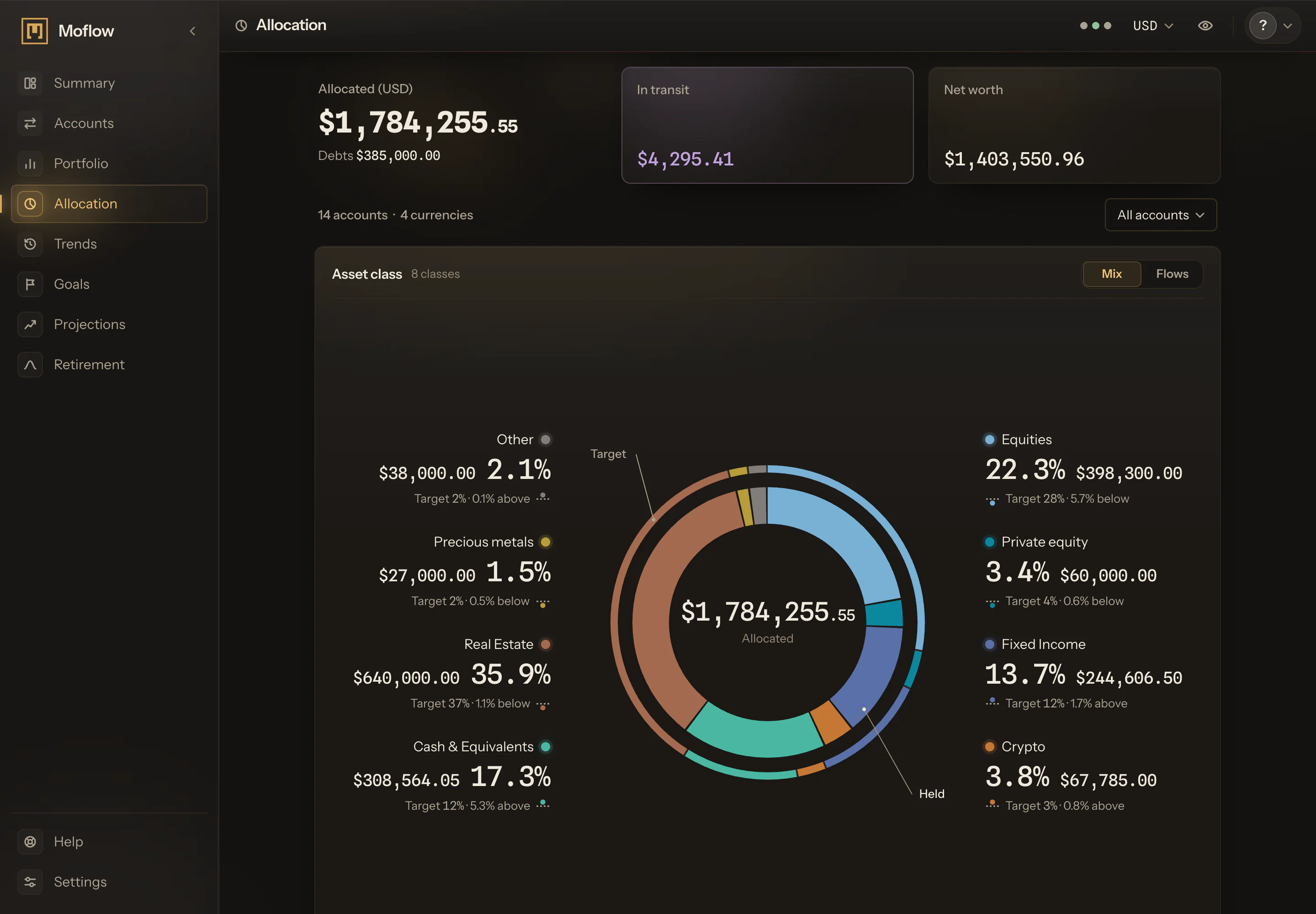
Your asset allocation, against your targets.

Asset classes against the targets you set, currency exposure, and the mix in every account you add.

  1. From currency to class

    Money traced from its currency, through your accounts, into asset classes.
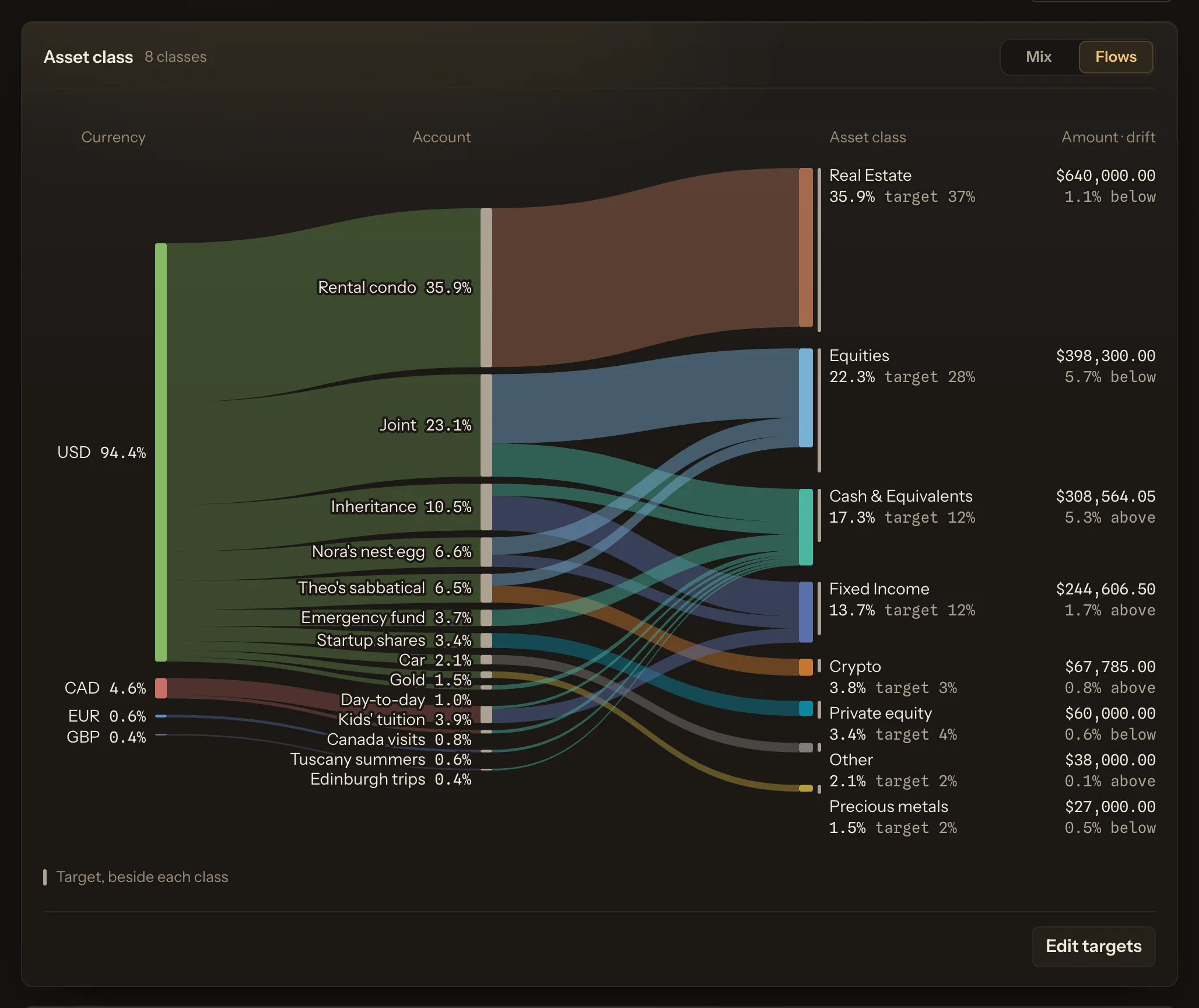
    In the frame, currencies stand on the left, accounts in the middle and asset classes on the right. One picture follows the money in three steps: the currency it is in, the account it sits in, and the asset class it lands in.

    A Canadian account of US shares shows as US dollars flowing into Equities. You see where your money sits, not where the account names suggest it does.

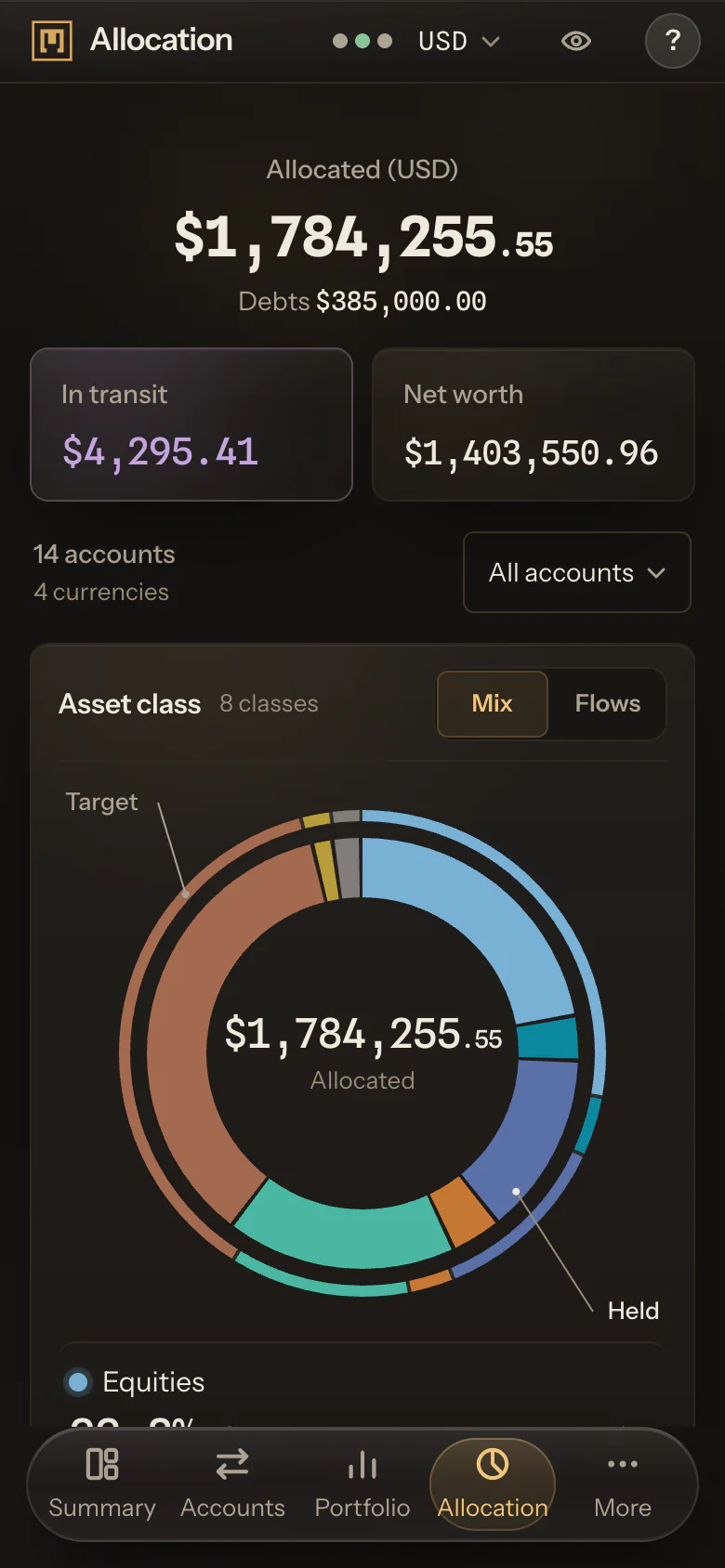
    On a phone, the flows start at the accounts, and each class keeps its share and its target. Each class shows its amount, its share, its target and its drift beside it, and wider streams carry more money.

    Set a target share for an asset class, and the gap between target and actual reads as a share of the total: 6.0% above, 2.0% below. The drift tolerance says how far a class may sit from its target before it reads past your tolerance.

  2. Your currency exposure

    How your money splits across currencies, as shares and amounts.

    On a phone, the currency split sits right under the flows. Currency exposure follows the holdings, not the account.

    US shares in a Canadian account count as US dollars, so a ledger kept mostly in Canadian dollars can still be half in US dollars. Exposure you might not see from account names shows up here.

    The currencies are the 38 Moflow carries, and your display currency is one of them. The split shows as shares of the total and as amounts in your display currency.

    Some balanced funds count in more than one class: one on Moflow's list of fixed-mix funds counts at its issuer's stated mix, such as Equities 60% and Fixed Income 40%, each part in its own class.

  3. Account by account

    One bar per account, split by asset class.

    A balanced total can hide two lopsided accounts. The bars show them: an account that is all Equities stands out beside one that is all cash.

    An account out of step with the rest is easy to spot, and the total no longer hides it.

    Open an asset class, and its sheet lists the holdings behind it, each with its share and the account it sits in. From the same sheet, Edit targets opens your target mix.

    Two accounts in different currencies can hold the same asset class, and the bars put them side by side.

A worked example: three accounts, two currencies, one target mix

Three accounts, four lines, two currencies. Display currency: the Canadian dollar, with 1 US dollar at 1.40.

AccountWhat is in itIn Canadian dollarsAsset classCurrency
A, in CADWhat is in itUS shares worth 150,000 USDIn Canadian dollars210,000Asset classEquitiesCurrencyUSD
B, in CADWhat is in itCanadian sharesIn Canadian dollars120,000Asset classEquitiesCurrencyCAD
B, in CADWhat is in itCanadian bondsIn Canadian dollars100,000Asset classFixed IncomeCurrencyCAD
C, in USDWhat is in itSavings of 50,000 USDIn Canadian dollars70,000Asset classCash & EquivalentsCurrencyUSD

The total is 500,000 CAD: Equities 66%, Fixed Income 20%, Cash & Equivalents 14%. By currency, 280,000 is in US dollars (56%) and 220,000 in Canadian dollars (44%), though two of the three accounts are kept in Canadian dollars.

With targets of 60%, 25% and 15%, Equities reads 6.0% above, Fixed Income 5.0% below and Cash & Equivalents 1.0% below. In amounts, 6.0% of 500,000 CAD is 30,000 CAD above the Equities target, and 5.0% is 25,000 CAD below the Fixed Income one.

At the default drift tolerance of 5%, Equities is past your tolerance, and Fixed Income, at exactly 5.0%, is within your tolerance. Nothing in the example was moved or traded: the targets describe the mix you want, and the page measures against them. These rates are for illustration only.

How do I see my asset allocation across several accounts?

Add the accounts and their holdings, and Moflow totals them by asset class in one display currency. The account bars then show the mix inside each one.

An account without holdings counts by its type: a savings account as Cash & Equivalents.

What is currency exposure in a portfolio?

How your money splits across currencies, counted by the currency the holdings are priced in. US shares in a Canadian account are US dollar exposure, so a ledger kept in one currency can still be exposed to several.

The split is shown as shares and as amounts.

What is asset allocation drift?

How far an asset class's share sits above or below its target: 66% held against a 60% target is 6.0% above. Up to your drift tolerance, 5% to start, it is within your tolerance; beyond it, past your tolerance.

Change the tolerance in Allocation, under Edit targets. The default is a starting point, not advice.

Does Moflow trade to match my targets?

No. Moflow shows where an asset class sits against its target; it never trades and never moves money.

What to do about a gap is your decision, and a gap inside your tolerance reads as within it.

Can a fund count in more than one asset class?

Some can. A balanced fund on Moflow's list of fixed-mix funds counts in each class at its issuer's stated mix, such as Equities 60% and Fixed Income 40%, in the total and in the account's bar.

Any other holding counts in one class.

Is allocation free?

Yes. Allocation, with its targets and drift, is on Free, and no card is needed. Your targets are saved with your ledger.

The ledger is free. Moflow+ connects it.

On Moflow+, many brokerages connect; the rest you keep by hand.

Try Moflow+

Moflow+ · $199 per year