Free

One portfolio across your accounts.

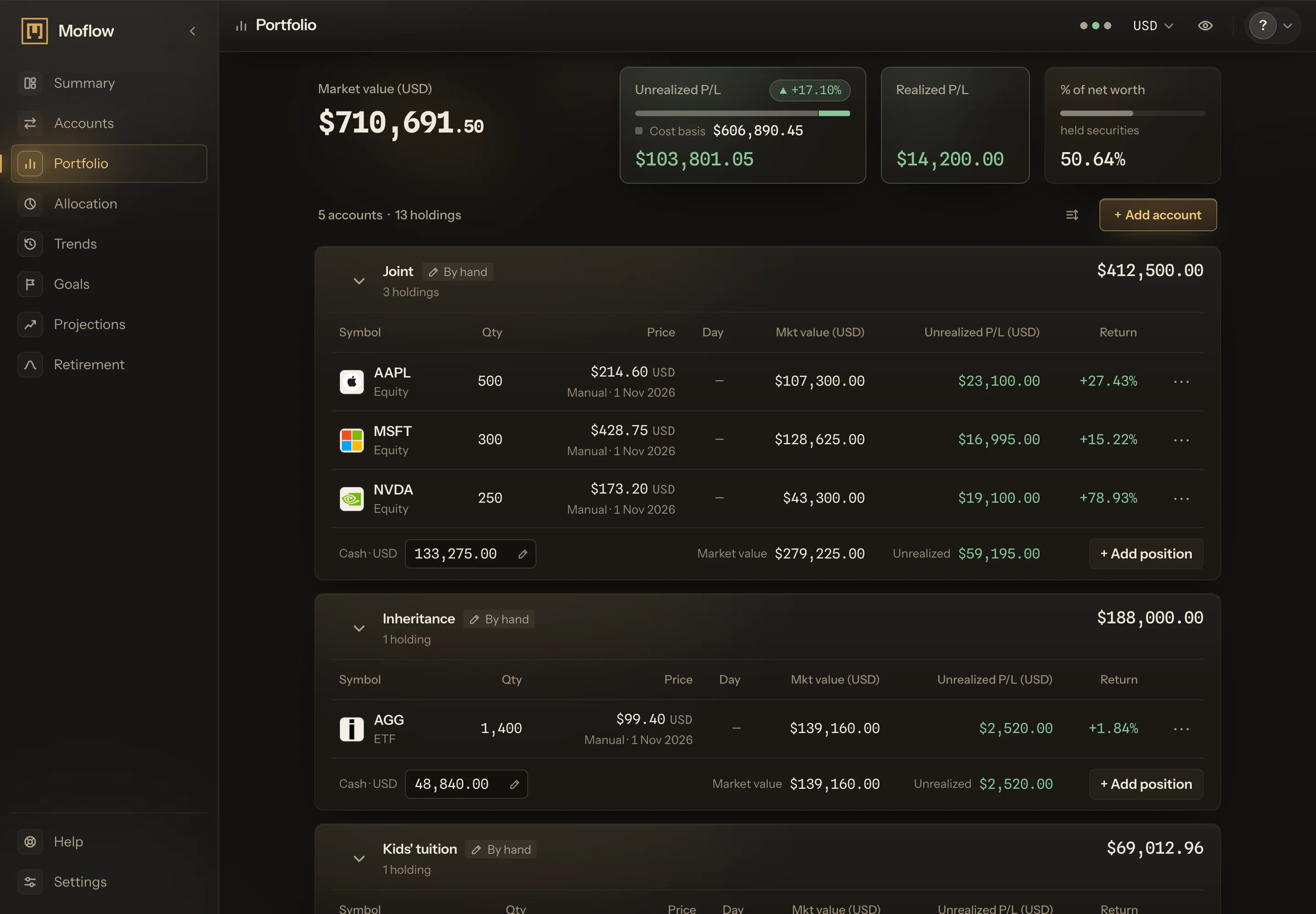
Holdings, cost, gains and weights for each account you add, totalled in one display currency.

  1. Worth against cost

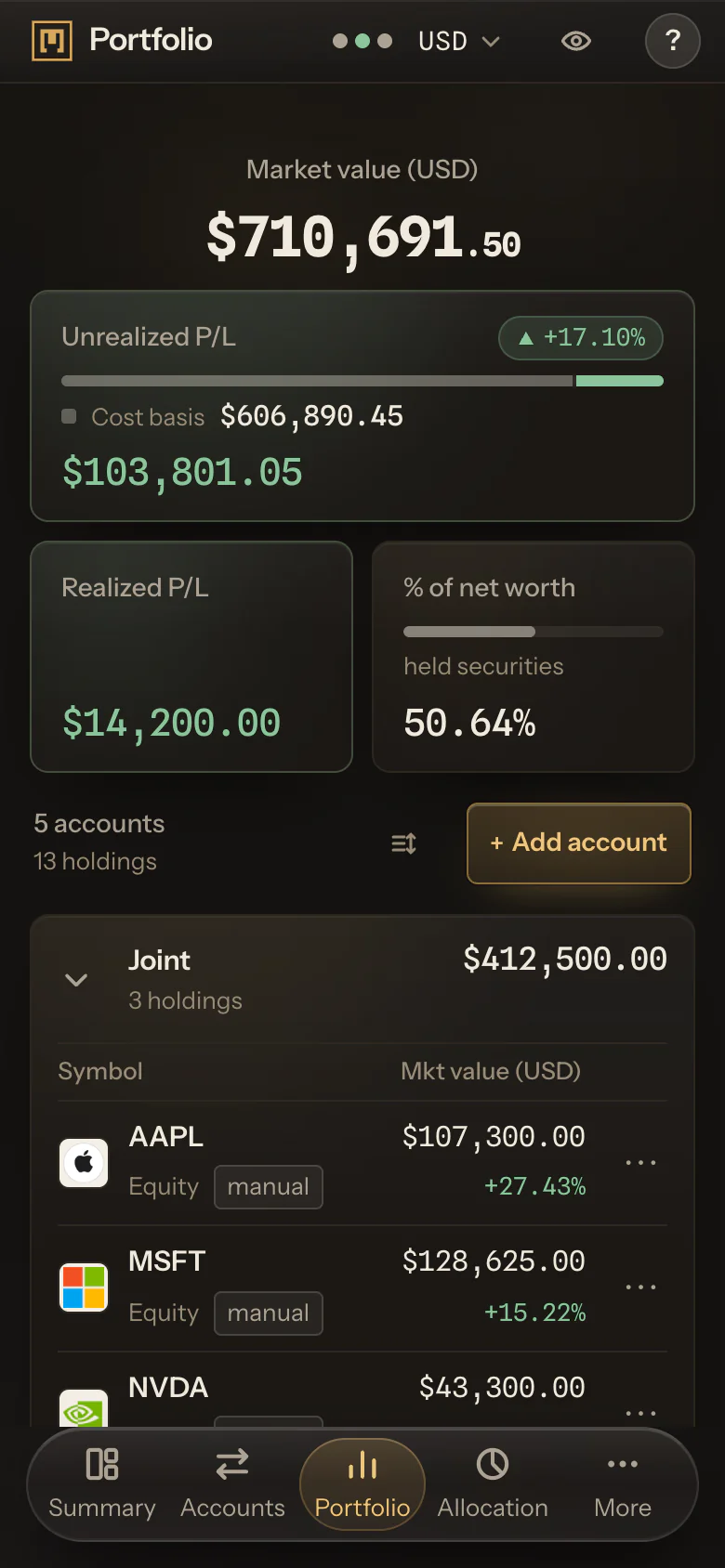
    Market value, cost basis, and profit or loss, realized and unrealized.

    Market value is what the holdings are worth at their price. Cost basis is what they cost.

    The gap between the two is unrealized profit or loss, and realized profit or loss is what the sales you recorded made over cost.

    Beside them sits the share of your net worth the holdings make up, so a gain reads against the size of what produced it.

    It answers two questions at once, across your accounts: what did this cost, and what is it worth?

    The figures are in your display currency, added across the accounts you invest through. Open one account, and its holdings are listed one by one, each with its quantity, its price and its value.

    A price you set shows as Manual, with the date you set it.

  2. Its own currency

    A USD holding in a CAD account stays in USD, and still counts in your total.

    A Canadian account can own shares listed in New York. Moflow keeps the holding in US dollars and the account's cash in Canadian dollars, so the two are never added as if they were one currency.

    Each converts into your display currency when it joins the total. So an account in one country with shares from another reads correctly, with no conversion column of your own.

    An investment account's cash sits beside its holdings, in the account's own currency, and counts in the account's value.

    Crypto works the same way: a coin is a holding with a quantity, a cost and a price.

  3. Each trade you record

    Buys and sales you record, with average cost and realized profit or loss.

    Record a purchase and Moflow blends its price into the average cost, weighted by quantity. Record a sale and Moflow books the profit or loss against that average; the shares left keep the same average cost.

    A holding you already own starts as one opening position, at its quantity and the price you paid, so its record starts the day you add it. What you paid stays with the holding, not in a separate file.

    Each holding keeps the list of trades recorded against it, so the average cost on screen traces back to the purchases behind it. Above the list sit the average cost, the realized and unrealized figures and the market value.

A worked example: US shares in a Canadian account

One account, one holding, two currencies. A Canadian dollar account records 100 shares of a US-listed fund, bought at 150 USD each: a cost basis of 15,000 USD. With the price at 180 USD, the market value is 18,000 USD, an unrealized profit of 3,000 USD, or 20%.

Then a sale of 20 shares at 180 USD is recorded. Against the 150 USD average, it realizes a profit of 600 USD. The 80 shares left keep the 150 USD average: a cost basis of 12,000 USD, a market value of 14,400 USD and an unrealized profit of 2,400 USD.

With the Canadian dollar as display currency and 1 US dollar at 1.40, the portfolio shows 20,160 CAD of market value, 3,360 CAD unrealized and 840 CAD realized. The holding itself stays in US dollars.

Had the 20 shares gone at 140 USD instead, the same arithmetic would book a realized loss of 200 USD, and the 150 USD average would still stand. The arithmetic is the same at any size. These rates are for illustration only.

How do I track US stocks in a Canadian account?

Add the account in Canadian dollars and record the holding in US dollars. Moflow keeps the two currencies apart, so the cost stays in the currency you paid, and converts both into your display currency for the total.

A euro account with US shares works the same way.

What is the difference between realized and unrealized gains?

Unrealized profit or loss is market value minus cost on what is still owned.

Realized profit or loss is what a recorded sale made over the average cost: a sale at 180 against a 150 average realizes 30 a share.

How is average cost basis calculated?

Each recorded purchase blends its price into the average, weighted by quantity: 100 bought at 150 and 100 at 170 average 160.

A sale books its profit or loss against that average and leaves the average where it was.

Where do the prices come from?

Every plan includes daily prices from our market-data provider.

Anything it cannot price is valued at the price you set, or at its cost.

Does Moflow place trades?

No. A trade recorded in Moflow is a line in your ledger: Moflow never places an order and never moves money.

Its prices value what you own, and nothing more.

Can I track crypto alongside stocks?

Yes. A coin is a holding like a share, with a quantity, a cost and a price, in the same accounts and the same total.

In Allocation, coins count in their own asset class, Crypto.

Moflow's daily prices are free. Moflow+ adds your AI.

Anything Moflow cannot price stays at cost or at the price you set.

Try Moflow+

Moflow+ · $199 per year